
AI-Augmented FinTech. Intelligence that compounds.
Oxvelo Compliance Report · July 2026How compliant is the web, really?
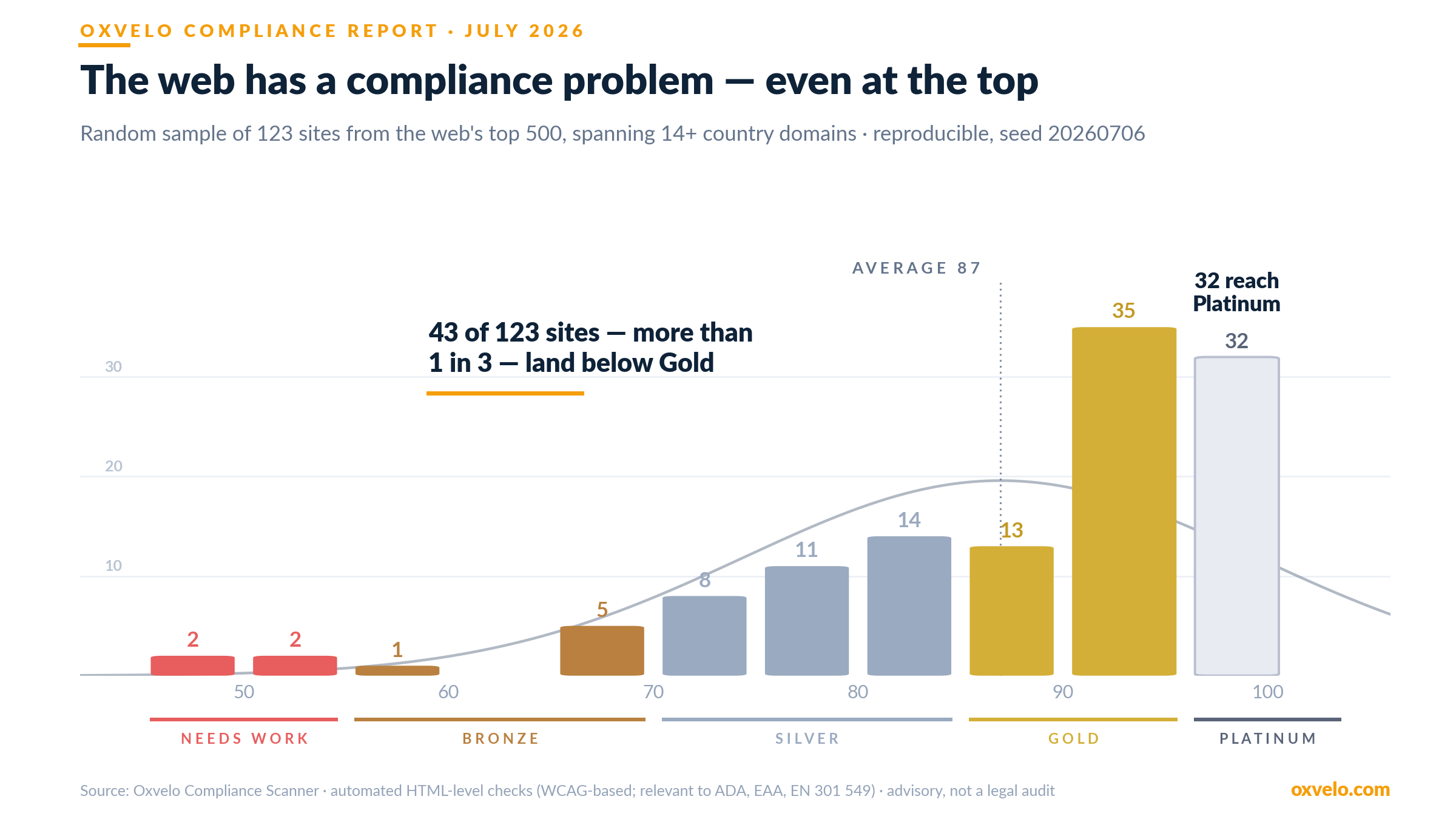
We scanned a random sample of the world's top websites — then zoomed in on the sectors the ADA and the Accessible Canada Act actually govern. The results say more about regulation than about technology.
1. The web at large: one in three falls short
To avoid cherry-picking, we drew a seeded random sample of 123 sites from the web's top 500 — spanning more than 14 country domains — and scanned every one live with the Oxvelo Compliance Scanner on July 6, 2026.
Then vs. now
Same sample, same rubric, rescanned by the Oxvelo Compliance Watcher. The dated baseline above never changes.
Note: live rescans read each site’s served HTML before JavaScript runs, so individual scores can differ from the browser-rendered baseline. Read the comparison as a trend, not as site-by-site verdicts.
The failures are not exotic: missing alt text, broken heading structure, unlabeled form fields — the basics screen-reader users collide with every day, and the exact defects cited in accessibility demand letters.
Appendix A — per-site results, global sample (123 individual sites)
| Site | Score | Tier |
|---|---|---|
| nytimes.com | 100 | Platinum |
| ebay.co.uk | 100 | Platinum |
| elmundo.es | 100 | Platinum |
| canva.com | 100 | Platinum |
| nikkei.com | 100 | Platinum |
| gofundme.com | 100 | Platinum |
| automattic.com | 100 | Platinum |
| behance.net | 100 | Platinum |
| w3.org | 100 | Platinum |
| pages.dev | 100 | Platinum |
| afternic.com | 100 | Platinum |
| dropbox.com | 100 | Platinum |
| cutt.ly | 100 | Platinum |
| loc.gov | 100 | Platinum |
| pinterest.com | 100 | Platinum |
| stanford.edu | 100 | Platinum |
| change.org | 100 | Platinum |
| hotmart.com | 100 | Platinum |
| vercel.app | 100 | Platinum |
| unesco.org | 100 | Platinum |
| www.wikipedia.org | 99 | Platinum |
| abc.net.au | 98 | Platinum |
| lavanguardia.com | 98 | Platinum |
| psychologytoday.com | 98 | Platinum |
| aol.com | 97 | Platinum |
| pexels.com | 97 | Platinum |
| abcnews.go.com | 97 | Platinum |
| safety.google | 97 | Platinum |
| nintendo.com | 97 | Platinum |
| foxnews.com | 96 | Platinum |
| franceinfo.fr | 96 | Platinum |
| variety.com | 96 | Platinum |
| sciencedirect.com | 95 | Gold |
| berkeley.edu | 95 | Gold |
| sagepub.com | 95 | Gold |
| fr.wikipedia.org | 95 | Gold |
| de.wikipedia.org | 95 | Gold |
| worldbank.org | 95 | Gold |
| mit.edu | 95 | Gold |
| issuu.com | 95 | Gold |
| wiktionary.org | 95 | Gold |
| mediafire.com | 95 | Gold |
| foodnetwork.com | 95 | Gold |
| yahoo.co.jp | 95 | Gold |
| apple.com | 95 | Gold |
| ziddu.com | 95 | Gold |
| epa.gov | 95 | Gold |
| ibm.com | 95 | Gold |
| uol.com.br | 95 | Gold |
| dw.com | 95 | Gold |
| ovh.com | 94 | Gold |
| hatena.ne.jp | 94 | Gold |
| enable-javascript.com | 94 | Gold |
| e-monsite.com | 93 | Gold |
| twitter.com | 93 | Gold |
| ja.wikipedia.org | 93 | Gold |
| networkadvertising.org | 92 | Gold |
| fifa.com | 92 | Gold |
| pnas.org | 91 | Gold |
| www.weebly.com | 91 | Gold |
| welt.de | 90 | Gold |
| nih.gov | 90 | Gold |
| my.yahoo.com | 90 | Gold |
| theatlantic.com | 90 | Gold |
| buzzfeed.com | 90 | Gold |
| playstation.com | 90 | Gold |
| addtoany.com | 90 | Gold |
| nypost.com | 89 | Gold |
| scholastic.com | 88 | Gold |
| udemy.com | 88 | Gold |
| spotify.com | 88 | Gold |
| britannica.com | 88 | Gold |
| creativecommons.org | 88 | Gold |
| it.wikipedia.org | 87 | Gold |
| sky.com | 87 | Gold |
| example.com | 85 | Gold |
| thedailybeast.com | 85 | Gold |
| thehill.com | 85 | Gold |
| giphy.com | 85 | Gold |
| archive.org | 85 | Gold |
| house.gov | 84 | Silver |
| pl.wikipedia.org | 84 | Silver |
| mashable.com | 83 | Silver |
| m.me | 83 | Silver |
| yadi.sk | 83 | Silver |
| cnbc.com | 83 | Silver |
| reg.ru | 82 | Silver |
| vk.com | 80 | Silver |
| yandex.com | 80 | Silver |
| vimeo.com | 80 | Silver |
| bbc.co.uk | 80 | Silver |
| acm.org | 80 | Silver |
| amazon.com | 80 | Silver |
| lwshosting.name | 80 | Silver |
| mystrikingly.com | 79 | Silver |
| youronlinechoices.com | 79 | Silver |
| amazon.co.uk | 79 | Silver |
| ted.com | 78 | Silver |
| amazon.de | 77 | Silver |
| reuters.com | 75 | Silver |
| standard.co.uk | 75 | Silver |
| elpais.com | 75 | Silver |
| inc.com | 75 | Silver |
| amazon.co.jp | 75 | Silver |
| instructables.com | 75 | Silver |
| dailymotion.com | 74 | Silver |
| php.net | 74 | Silver |
| twitch.tv | 73 | Silver |
| itch.io | 73 | Silver |
| arxiv.org | 71 | Silver |
| google.de | 71 | Silver |
| google.com.br | 71 | Silver |
| google.fr | 71 | Silver |
| godaddy.com | 65 | Bronze |
| cointernet.com.co | 65 | Bronze |
| mdpi.com | 65 | Bronze |
| estadao.com.br | 65 | Bronze |
| fb.com | 65 | Bronze |
| myspace.com | 56 | Bronze |
| news.com.au | 50 | Needs Work |
| t.me | 50 | Needs Work |
| photos1.blogger.com | 45 | Needs Work |
| istockphoto.com | 45 | Needs Work |
2. What's actually broken: the failures behind the scores
Averages hide the mechanics. Across all 123 sites in the global sample, these are the specific checks that failed most often — each one a concrete defect with a concrete victim[8]:
Why oxvelo flags these. A page without a single H1 has no reliable outline, so screen-reader users can't skim — they hear the page one element at a time. A link without an accessible name is announced simply as "link," which is as useful as a road sign that says "sign." Missing form labels turn checkout and booking flows into guesswork — and checkout and reservation flows are precisely where ADA web lawsuits concentrate[2]. Missing landmarks strip away the "skip to content" shortcuts assistive tech depends on. None of these failures require redesigns; they are markup-level defects, typically hours — not months — of work to fix.
3. The ADA edition: the most-sued sectors score worst
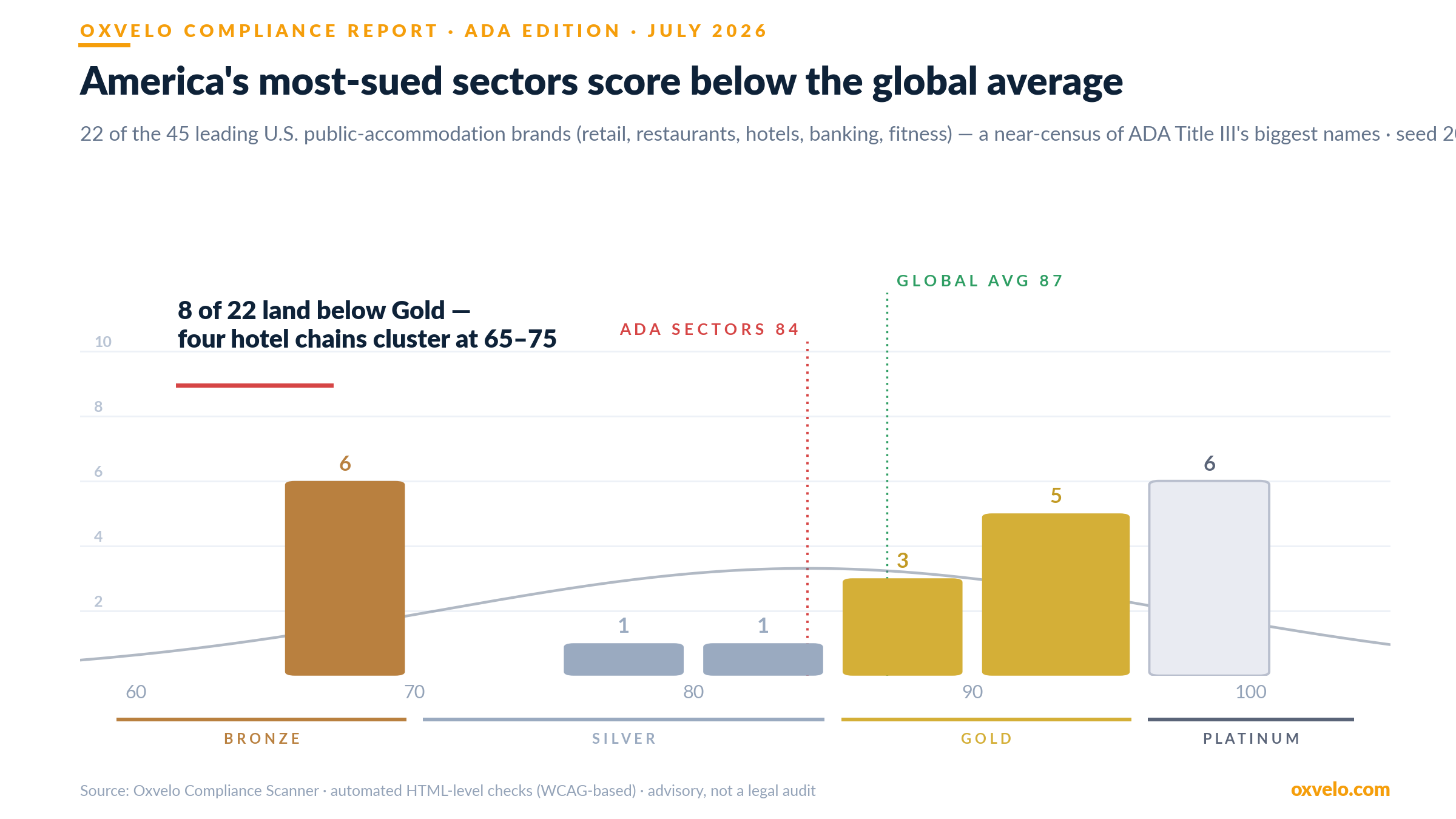
ADA Title III covers "places of public accommodation" — retail, restaurants, hotels, banks, gyms. These sectors drove much of the record 5,000+ U.S. digital-accessibility lawsuits filed in 2025[1]. We scanned 22 of the 45 leading brands in those sectors — a near-census of the biggest names, not a thin sample.
"Most-sued" is measurable. EcomBack's annual tracking of 3,948 ADA website lawsuits filed in 2025 breaks the concentration down by sub-sector[9]:
| Sub-sector (EcomBack taxonomy) | 2025 lawsuits | Share of 3,948 tracked |
|---|---|---|
| Retail eCommerce — combined | 1,891 | 47.9% |
| Lifestyle, fashion & apparel | 1,025 | 26.0% |
| Beauty & personal care | 317 | 8.0% |
| Home, furniture & decor | 303 | 7.7% |
| Sports & fitness accessories | 89 | 2.3% |
| General retail / multi-category goods | 89 | 2.3% |
| Toys, games, gifts & specialty retail | 68 | 1.7% |
| Restaurants, food & beverages | 1,368 | 34.7% |
| Health & medical | 283 | 7.2% |
| All other sub-sectors | 406 | 10.3% |
Broader tallies agree on the shape: UsableNet's 5,000+ count for 2025 (including state-court filings) groups these same categories as roughly 70% eCommerce & retail and 21% food service[2]. Both trackers are accessibility vendors; we cite them because their sector shapes converge with each other and with the federal filing counts published by defense-side law firm Seyfarth Shaw[1] — three independent tallies, one consistent picture.
Then vs. now
Same sample, same rubric, rescanned by the Oxvelo Compliance Watcher. The dated baseline above never changes.
Note: live rescans read each site’s served HTML before JavaScript runs, so individual scores can differ from the browser-rendered baseline. Read the comparison as a trend, not as site-by-site verdicts.
Naming names at the sector level, from our scan data:
| Sector (ADA Title III) | Scanned | Avg score | Below Gold | Range |
|---|---|---|---|---|
| Hotels & lodging | 5 | 72 | 4 of 5 | 65–90 |
| Retail & grocery | 9 | 81 | 3 of 9 | 65–100 |
| Consumer banking | 2 | 92 | 1 of 2 | 83–100 |
| Fitness & entertainment | 2 | 95 | 0 of 2 | 90–100 |
| Restaurants | 4 | 97 | 0 of 4 | 90–100 |
The hotel problem. Lodging was the weakest sector we measured anywhere in this report: an average of 72, with four of five major chains below Gold and three tied at 65. Here is the uncomfortable pairing: travel and hospitality drew only ~1% of 2025 filings[2] — yet posted the worst scores we measured anywhere. In oxvelo's assessment, that is not safety; it is unexploited exposure, concentrated in exactly the flows DOJ guidance and past litigation waves target: online reservations[10]. The reverse case proves the mechanism. Food service — where filings doubled to 21% of all 2025 lawsuits[2] — is where the major chains we scanned now average 97. The big brands cleaned up under pressure; the lawsuits are moving down-market to operators who have not. Hotels, on this evidence — again, oxvelo's read of its own scan data — are simply earlier on the same curve.
Appendix B — per-site results, ADA edition (22 individual sites)
| Site | Score | Tier |
|---|---|---|
| wholefoodsmarket.com | 100 | Platinum |
| dennys.com | 100 | Platinum |
| chase.com | 100 | Platinum |
| lifetime.life | 100 | Platinum |
| chipotle.com | 99 | Platinum |
| wendys.com | 98 | Platinum |
| regmovies.com | 90 | Gold |
| gap.com | 90 | Gold |
| hyatt.com | 90 | Gold |
| ihop.com | 90 | Gold |
| nordstrom.com | 90 | Gold |
| homedepot.com | 85 | Gold |
| macys.com | 85 | Gold |
| bestbuy.com | 85 | Gold |
| bankofamerica.com | 83 | Silver |
| bestwestern.com | 75 | Silver |
| choicehotels.com | 65 | Bronze |
| marriott.com | 65 | Bronze |
| ihg.com | 65 | Bronze |
| traderjoes.com | 65 | Bronze |
| lowes.com | 65 | Bronze |
| kohls.com | 65 | Bronze |
4. The ACA counterpoint: proactive standards work
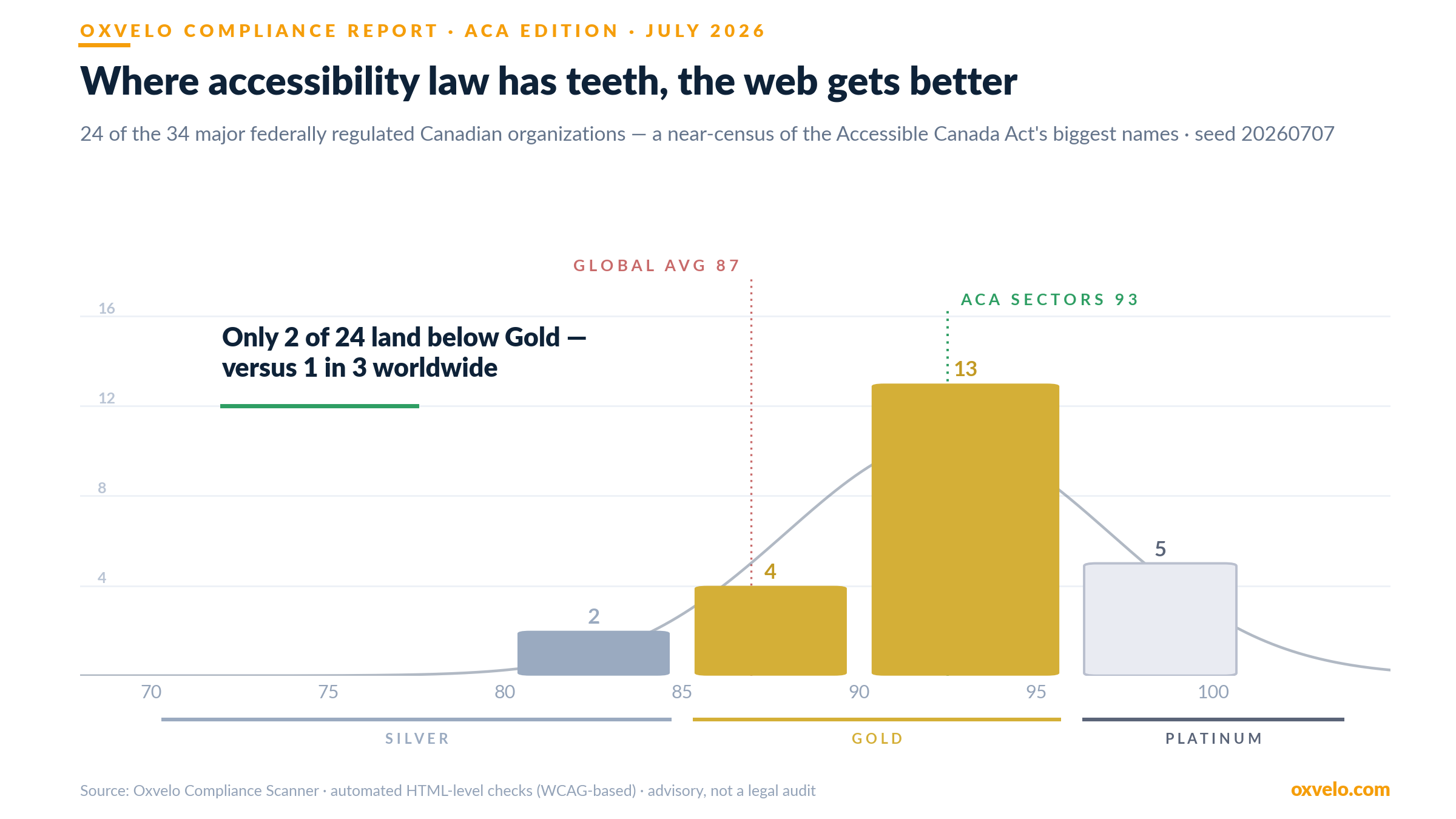
Canada's Accessible Canada Act takes the opposite approach: proactive, standards-based regulation (CAN/ASC – EN 301 549) applied to federally regulated sectors — banks, telecoms, airlines, rail, broadcasters, and federal agencies. We scanned 24 of the 34 major organizations in that scope: again, a near-census.
Then vs. now
Same sample, same rubric, rescanned by the Oxvelo Compliance Watcher. The dated baseline above never changes.
Note: live rescans read each site’s served HTML before JavaScript runs, so individual scores can differ from the browser-rendered baseline. Read the comparison as a trend, not as site-by-site verdicts.
The same sector-level view on the Canadian side:
| Sector (ACA, federally regulated) | Scanned | Avg score | Below Gold | Range |
|---|---|---|---|---|
| Banks | 6 | 97 | 0 of 6 | 94–100 |
| Telecoms | 5 | 94 | 0 of 5 | 93–96 |
| Federal agencies & postal | 5 | 92 | 0 of 5 | 85–100 |
| Airlines | 5 | 90 | 1 of 5 | 84–94 |
| Rail | 2 | 88 | 0 of 2 | 87–88 |
| Broadcasters | 1 | 84 | 1 of 1 | 84 |
Note the pattern: Canadian banks — regulated by both OSFI and the ACA's proactive standards[5] — post the strongest sector average in this entire report (97), and not a single Canadian sector we scanned averaged below Silver. The floor is higher everywhere.
Appendix C — per-site results, ACA edition (24 individual sites)
| Site | Score | Tier |
|---|---|---|
| eqbank.ca | 100 | Platinum |
| laurentianbank.ca | 100 | Platinum |
| canada.ca | 100 | Platinum |
| td.com | 97 | Platinum |
| freedommobile.ca | 96 | Platinum |
| tangerine.ca | 95 | Gold |
| telus.com | 95 | Gold |
| bell.ca | 94 | Gold |
| airtransat.com | 94 | Gold |
| videotron.com | 94 | Gold |
| nbc.ca | 94 | Gold |
| rbc.com | 94 | Gold |
| rogers.com | 93 | Gold |
| statcan.gc.ca | 93 | Gold |
| cmhc-schl.gc.ca | 92 | Gold |
| westjet.com | 92 | Gold |
| aircanada.com | 90 | Gold |
| canadapost-postescanada.ca | 90 | Gold |
| flyporter.com | 89 | Gold |
| cpkcr.com | 88 | Gold |
| viarail.ca | 87 | Gold |
| bankofcanada.ca | 85 | Gold |
| ctvnews.ca | 84 | Silver |
| flairair.ca | 84 | Silver |
5. The legal landscape: why this is accelerating
Three regulatory currents are converging. In the United States, plaintiffs filed 3,117 website-accessibility lawsuits in federal court in 2025 — a 27% jump over 2024 — and more than 5,000 including state courts, concentrated in New York, California, and Florida[1][2]. ADA Title III's definition of "public accommodation" is what pulls retail, restaurants, hotels, banks, and gyms into scope[7], and the Department of Justice's guidance points businesses to WCAG as the reference standard[10].
In Europe, the European Accessibility Act became applicable on June 28, 2025, extending WCAG-based requirements (via EN 301 549) to e-commerce, banking, and consumer services across all EU member states[3][4]. And in Canada, the Accessible Canada Act's proactive model — the one that produced the strongest scores in this report — is scheduled to push federally regulated organizations toward full accessibility by 2040, with standards harmonized to EN 301 549[5][6].
The direction is uniform: WCAG-based obligations, spreading jurisdiction by jurisdiction, with enforcement shifting from reactive lawsuits to proactive standards. The data in sections 3 and 4 shows what each regime produces.
The EU: the same defects, now with a statute
The European Accessibility Act (Directive (EU) 2019/882) has applied to new products and services since June 28, 2025. Its technical yardstick, EN 301 549, incorporates the same WCAG criteria measured throughout this report — so every score on this page reads directly onto EU obligations. The Act covers e-commerce, banking, transport, telecoms and more, and is enforced by each member state's market-surveillance authorities, with penalties set nationally.
Our global sample was drawn worldwide and includes six EU country-code domains — far too few for statistics, but an honest first look, scored by the identical rubric (one Slovak-TLD domain hack operated outside the EU is excluded):
| Site | Score | Tier |
|---|---|---|
| elmundo.es | 100 | Platinum |
| franceinfo.fr | 96 | Platinum |
| welt.de | 90 | Gold |
| amazon.de | 77 | Silver |
| google.de | 71 | Silver |
| google.fr | 71 | Silver |
Average: 84 — below the global sample's 87 — with half the subset under Gold, including flagship properties of some of the region's largest operators. Two caveats keep this honest: six sites prove nothing statistically, and EU-market sites running on .com domains are invisible to country-code counting, so this subset understates the true EU footprint. A dedicated EU edition with a properly drawn sample is planned; the EAA's first enforcement wave will make it considerably more interesting.
6. oxvelo's suggested five fixes, in order of impact
oxvelo’s recommendations, mapped directly to the failure rates in section 2 — all markup-level, none requiring a redesign:
Fix your heading structure. One H1 per page, nested H2–H4 below it. The single most common failure we found (41% of sites), and the cheapest to fix.
Name every link and button. Icon buttons and image links need aria-labels. "Link" announced forty times is not navigation (38% of sites failed).
Add landmarks. A <main> element and a skip link — one hour of work, failed by 34% of sites, and the difference between navigating and wading.
Label every form field. Especially checkout, booking, and reservation flows — the highest-litigation surfaces on the web[2].
Close the alt-text gap. 27% of sites have images with no alternative text; product and menu images are the usual offenders and the most commonly cited defect in demand letters.
Methodology & reproducibility
- Scanner: Oxvelo Compliance Scanner — 11 automated HTML-level checks (language attribute, titles, metadata, viewport, heading structure, image alt coverage, form labels, link/button accessible names, landmarks), scored 0–100 and mapped to tiers: Platinum 96+, Gold 85–95, Silver 70–84, Bronze 55–69.
- Global sample: n=123, seeded random draw (mulberry32, seed 20260706) from a published top-500 list (~485 usable domains after excluding infrastructure/redirects); unreachable sites dropped. With the finite-population correction, the sample mean of 86.9 carries a margin of error of roughly ±2 points at 95% confidence.
- ADA edition: 22 of a documented pool of 45 leading U.S. public-accommodation brands (seed 20260708).
- ACA edition: 24 of the 34 major federally regulated Canadian organizations (seed 20260707).
- Scan date: July 6, 2026. Websites change constantly; scores reflect that date.
- Scoring rubric: the full 11-check rubric, weights, WCAG mapping, and tier thresholds are published at reports.oxvelo.com/methodology.html (Rubric v1).
- Reproducibility: the sampling seeds and full per-site results are published; any individual score can be re-checked by anyone via the free public scanner at scan.oxvelo.com. The scoring engine itself runs server-side.
- Open data: the full per-site datasets (CSV and JSON, with all 11 check results, sectors, weights, and seeds) are published under CC BY 4.0: data package · metadata.json.
- Limitations: automated homepage checks are indicators, not a full WCAG audit and not a legal determination of compliance with any statute — only a minority of WCAG success criteria are automatically testable at all, so a high score here is necessary but not sufficient for full accessibility. Scores describe measured HTML characteristics of the homepage only.
7. If you'd rather not do it yourself
Every fix in section 6 is work Oxvelo does daily — it's the reason this report exists. Three ways we take compliance off your plate:
Oxvelo Shield — $79/month. Keep your existing website; we make it compliant, fast, and secure: WCAG 2.1 AA and ADA fixes, monthly compliance scans, and the issues in section 2 repaired at the markup level — typically within days, not quarters.
Oxvelo Website Refurbisher. When a site is too old to patch, we rebuild it to modern standard — fully responsive, accessible, and platform-agnostic — the same service behind the before-and-after work in our portfolio.
Oxvelo Compliance Badge + Watcher. Once you pass, the verifiable badge shows your customers — and any opportunistic plaintiff's firm — that you take this seriously, while the Watcher monitors every page continuously and alerts you the moment anything drifts out of compliance.
Every organization scanned in this report can request its full detailed results, free: info@oxvelo.com.
References
- Seyfarth Shaw LLP, "Federal Court Website Accessibility Lawsuit Filings Bounce Back in 2025," ADA Title III blog, March 2026 — 3,117 federal filings in 2025, +27% vs 2024. adatitleiii.com
- UsableNet Inc., ADA Website Compliance Lawsuit Tracker and 2025 reports — 5,000+ total digital-accessibility suits including state courts; industry shares for 2025: eCommerce 70%, food service 21% (up from 11% in 2024), healthcare 2%, fitness 2%, entertainment, travel, and education ~1% each; reservation and checkout flows as primary targets. Year-end report: 2025 Year-End Digital Accessibility Lawsuit Report (PDF) · usablenet.com
- Directive (EU) 2019/882 (European Accessibility Act), applicable June 28, 2025. eur-lex.europa.eu
- ETSI EN 301 549, Accessibility requirements for ICT products and services — the EU technical standard implementing WCAG. etsi.org
- Accessible Canada Act, S.C. 2019, c. 10 — proactive accessibility obligations for federally regulated entities; full accessibility target 2040. laws-lois.justice.gc.ca; CAN/ASC – EN 301 549 via Accessibility Standards Canada. accessible.canada.ca
- W3C, Web Content Accessibility Guidelines (WCAG) 2.1. w3.org/TR/WCAG21
- Americans with Disabilities Act, Title III, 42 U.S.C. §12181 et seq. — definition of "public accommodation." ada.gov
- Oxvelo LLC, live scan data, July 6, 2026 — random samples with published seeds (20260706 global; 20260707 ACA; 20260708 ADA); full per-site results in the tables above; sampling frame for the global study: Kikobeats top-sites list. github.com/Kikobeats/top-sites
- EcomBack, 2025 ADA Website Compliance Lawsuit Annual Report — 3,948 filings tracked in 2025 (+23.8% vs 2024); sub-sector shares: restaurants/food 34.65%, lifestyle/fashion/apparel 25.96%, beauty 8.03%, home & furniture 7.67%, health & medical 7.17%. ecomback.com
- U.S. Department of Justice, Guidance on Web Accessibility and the ADA. ada.gov/resources/web-guidance
About Oxvelo
Oxvelo LLC (oxvelo.com) is the white-label SaaS business platform with fintech-grade payments and compliance, serving 67 industries. The Oxvelo Compliance Scanner, Oxvelo Compliance Badge, and Oxvelo Compliance Watcher — the tools behind this report — audit, certify, and continuously monitor website accessibility for businesses and government organizations. This report may be cited with attribution to Oxvelo LLC and a link to oxvelo.com. The underlying datasets are published as open data (CC BY 4.0) in the data package, and the report is freely available as a PDF.
Media & data inquiries: info@oxvelo.com
Where does your site stand?
Run the same scanner on your website — free, 60 seconds, no signup. If it finds problems, fixes start at $999 — verified rescan and badge included.
Scan your site freeThis report practices what it measures: this page scores 100/100 — Platinum on the same 11-check rubric published above. Don't take our word for it — run reports.oxvelo.com through the free scanner yourself.